

TheWhiteBox · Independent AI analysis
Historical Deals & Mental Imagery Models
Sign in or subscribe to keep reading ↓

TLDR;
Welcome back! Today, we look at the recent AI successes of Tesla, OpenAI and Oracle’s record-setting deal, and new features coming from two of the hottest AI startups.
Finally, our trend of the week highlights a beautiful piece of research from MIT that proposes equipping models with the ability to construct mental images, thereby enhancing their reasoning capabilities.
Enjoy!


AUTONOMOUS DRIVING
Tesla Car Drives Autonomously Through Madrid
Tesla has released a video of one of its cars driving autonomously through the city of Madrid, where I happen to live.
A really impressive video that showcases the undeniable future of cars. As a negative point, it’s pending regulatory approval, yet another example of how Europe fails to maintain the pace set by the US and China due to excessive bureaucracy.
They claim to be doing so in the interests of Europeans, but the truth is, they are just under pressure to justify the absurd number of European bureaucrats whose jobs depend on those regulations existing in the first place.
Added to the first autonomous delivery that Tesla performed last week, it’s clear that years of effort are finally yielding success.
But will that be enough to compete with Waymo?
TheWhiteBox’s takeaway:
You’re probably asking: what makes Tesla’s cars different from Waymo's? Well, it’s two things:
The technological approach: Teslas rely on an AI vision model and cameras and sensors as input. Waymo relies on LiDAR (Light Detection and Ranging), a remote sensing technology that uses laser pulses to measure distances and create precise, high-resolution 3D maps of objects and environments. Both rely on AI models to drive the car; the input is what distinguishes them.
Depth vs breadth: Waymo focuses on depth, meaning its technology is designed ad hoc to the place it’s being deployed. On the other hand, Tesla aims for breadth, just like humans; the same software that drives a car through Phoenix drives it through Madrid (albeit I assume some fine-tuning is done to handle different driving rules).
While Tesla is a generic software, it doesn’t handle edge cases as well as Waymo due to the latter’s higher location-specificity (and cameras can also be blinded, unlike LiDAR).
If you want to compare both systems, you have to compare Waymo with the Tesla RoboTaxi (which is not what it’s being shown in the video above), and which I believe does rely more on ad hoc software than Tesla’s general software.
Bottom line, both approaches are quite different, which is why the comparisons between the two systems aren’t entirely valid.
CODING
TogetherAI open-SOTA Coder, DeepSWE
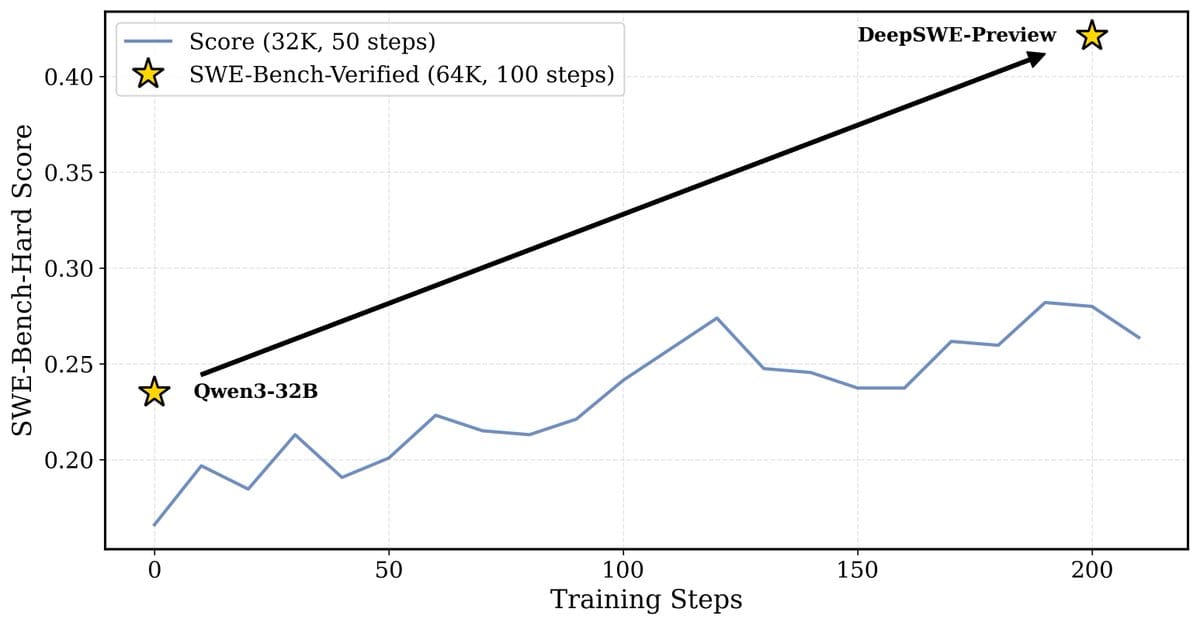
TogetherAI has open-sourced a remarkable new model, called DeepSWE, which excels at coding tasks and ranks among the top open-source models.
This model is a fine-tuned version of Alibaba’s Qwen 32B model, enhancing its coding performance in the popular SWEBench to more than double that of the original model.
As with all things progress in AI these days, the secret is nothing but Reinforcement Learning all over again; training models to achieve goals in…
Enjoyed the introduction? Subscribe or sign in to continue with this edition.
TheWhiteBox · Subscriber access
Keep reading.
Already subscribed? Sign in with your newsletter email.